
Tool review
OAKWOOMA Crochet Blocking Board: what to know before buying
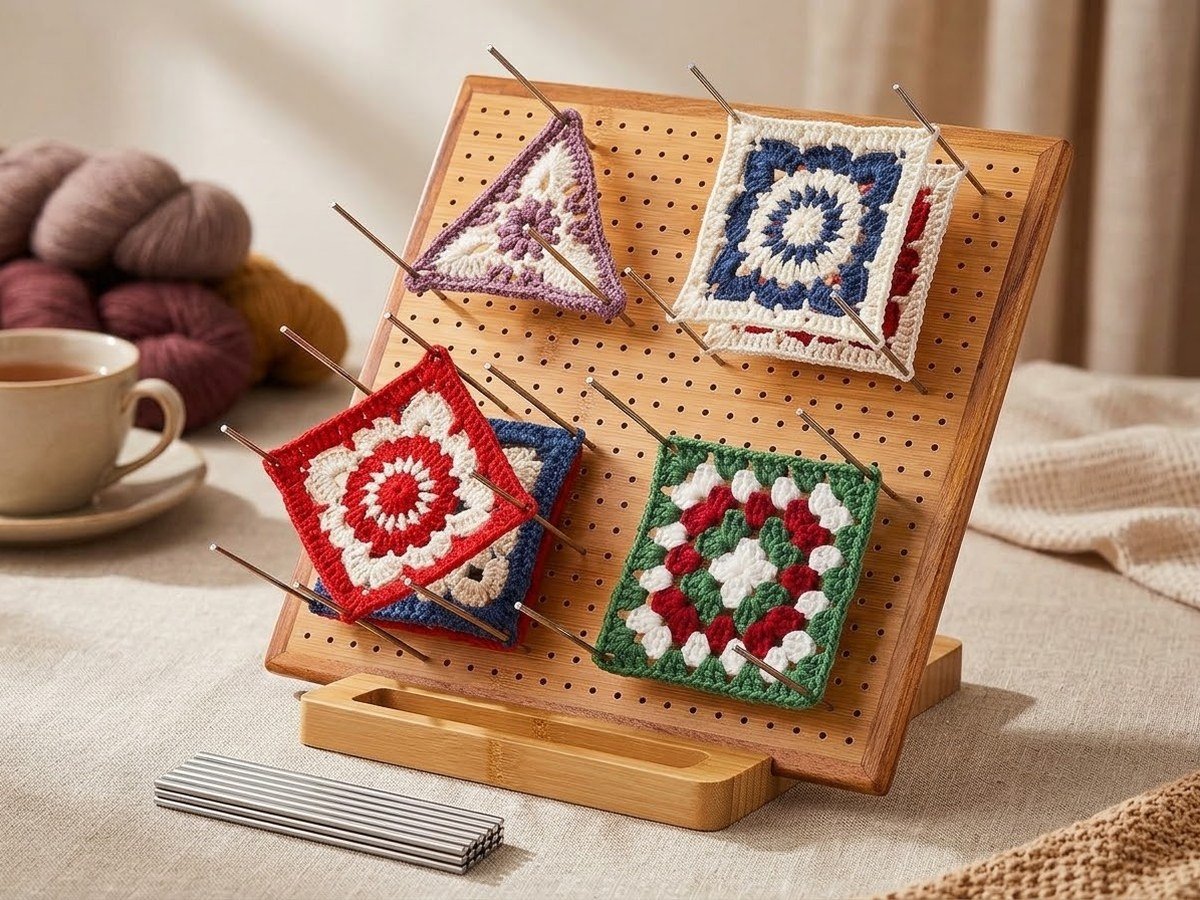
A wooden pegboard-style blocking board sized for granny squares and other smaller crochet motifs, with a 529-hole grid and 20 included pins. Here is what the listing documents about its size, grid and construction, and what to consider before buying — this is an editorial guide based on supplied product information, not a hands-on test.
This article contains affiliate links. As an Amazon Associate I earn from qualifying purchases.
Affiliate link — CrochetSmith may earn a commission from qualifying purchases at no extra cost to you.
Quick facts
- Brand
- OAKWOOMA
- Type
- Crochet blocking board
- Shape
- Square
- Dimensions
- 11.81 × 11.81 × 0.59 in
- Weight
- 3.08 lb
- Grid
- 529 holes / 23 holes per row
- Pins
- 20 stainless-steel pins
- Pin length
- 5 in
- Pin diameter
- 3 mm
- ASIN
- B0FQP42CQK
What this blocking board is designed to do
Blocking is the step where a finished piece is dampened or steamed and pinned to size so the stitches sit flat and even before it is used. A dedicated blocking board like this one gives you a stable surface with pre-drilled holes to pin into, rather than improvising with a towel, a mat or a cushion. This particular board is sized around smaller motifs — granny squares, mandalas and lace swatches — rather than a full garment or blanket, which shapes what it is and isn't suited for; we come back to that under "Things to consider" below.
The 529-hole grid
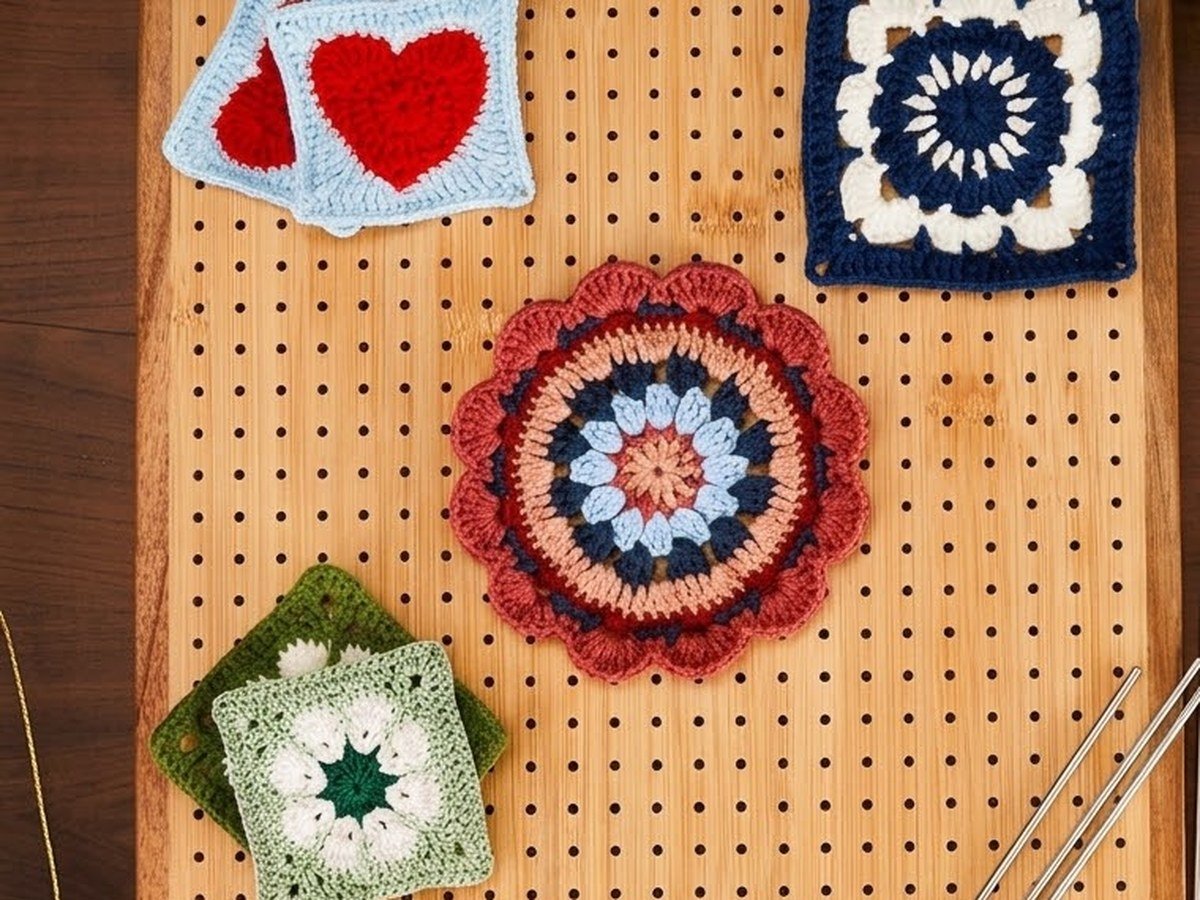
The listing describes a 529-hole grid, arranged 23 holes per row across the board's roughly 11.8-inch square face. A dense, regularly spaced grid like this is what lets you pin a motif into an even shape rather than being limited to a handful of fixed anchor points — useful for the scalloped or curved edges typical of granny squares, flowers and mandalas, where pins need to follow a shape rather than a straight line.
Affiliate link — CrochetSmith may earn a commission from qualifying purchases at no extra cost to you.
Using it with granny squares and crochet motifs
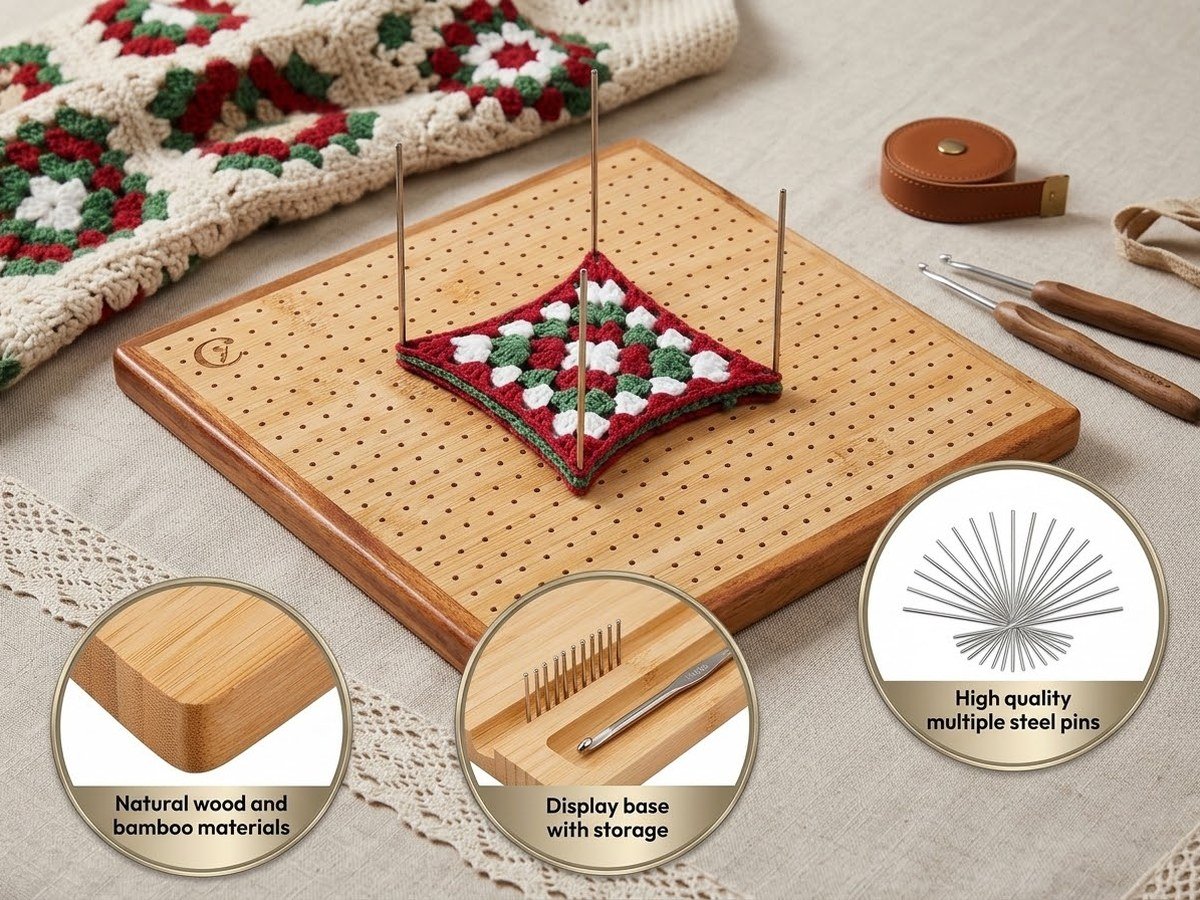
The supplied product photography shows a single granny square pinned into shape on the board, along with close-up insets of the bamboo edge, the pin-storage base and the bundle of pins themselves. The general idea a board like this supports is pinning a motif at its points or curves so it dries or sets in that shape; how many pins a given motif needs, and exactly where, depends on the motif's own shape rather than anything specific to this board.
Affiliate link — CrochetSmith may earn a commission from qualifying purchases at no extra cost to you.
Board size and workspace
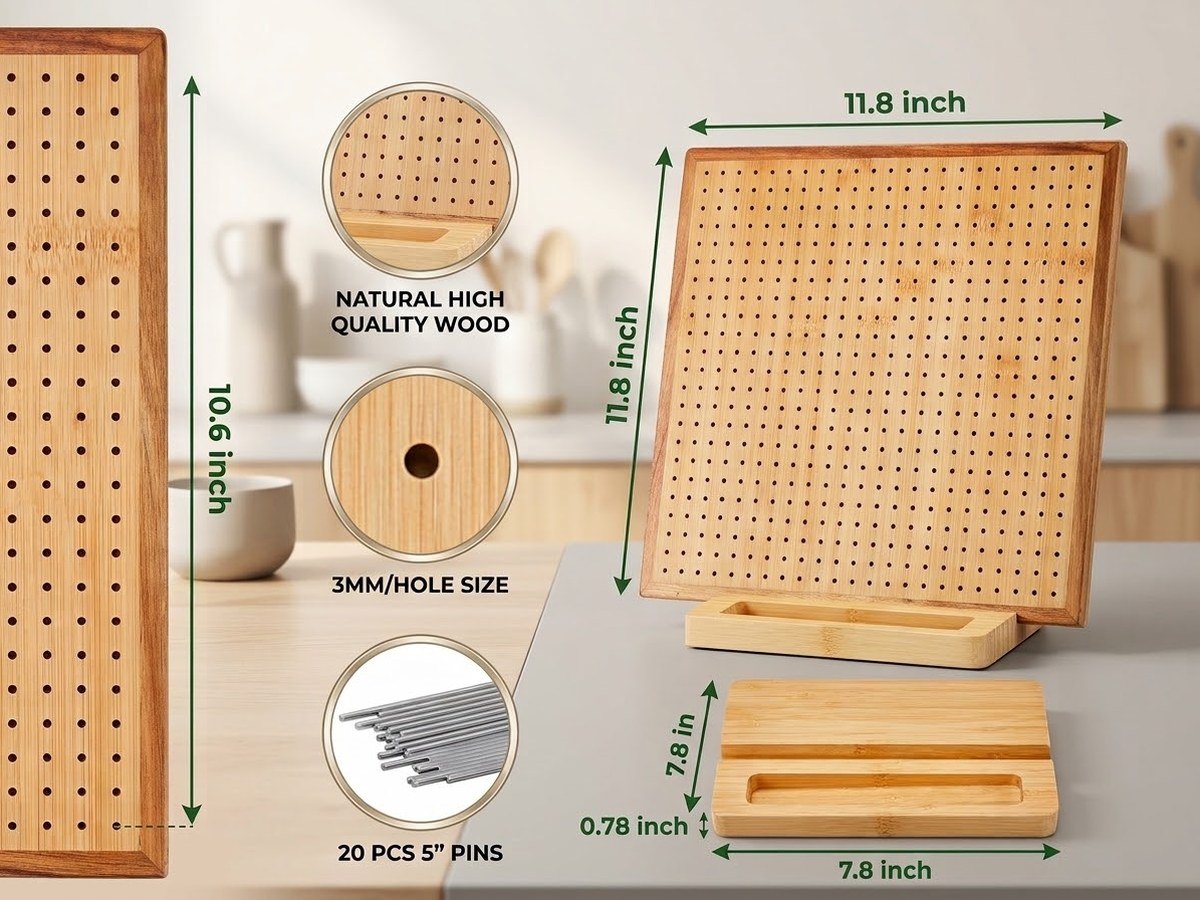
The listing gives the board's face as 11.81 by 11.81 inches and 0.59 inches thick, weighing 3.08 lb, with a separate storage base measured elsewhere in the supplied graphic at roughly 7.8 by 7.8 by 0.78 inches. At just under a foot square, this comfortably fits one or two granny squares or a motif at a time on a table or desk, but it is worth measuring your own workspace against those figures before buying, particularly if you were picturing something larger.
Affiliate link — CrochetSmith may earn a commission from qualifying purchases at no extra cost to you.
The pins and storage base
The set includes 20 pins, listed at 5 inches long and 3 mm in diameter, described as stainless steel. The base beneath the board is listed as bamboo and includes a slot for storing the pins when they are not in use, shown in the supplied photography. We have not tested these pins for rust resistance or long-term durability ourselves, so we are reporting stainless steel as the listed material rather than confirming its performance.
Materials and construction
The listing describes a bamboo panel set into a solid-wood frame, with a separate solid bamboo base. Bamboo and wood are common choices for blocking boards because they are rigid and take pins repeatedly without the holes wearing out as quickly as foam might, but CrochetSmith has not tested this specific board's long-term durability, so we are not making a claim about how it holds up over time.
Wet blocking considerations
The listing describes this board as suitable for wet blocking, where a finished piece is dampened and pinned to the board to dry in shape. That is a listed, intended use rather than something CrochetSmith has verified through repeated use: we have not tested this particular board for warping, long-term water resistance or how its finish holds up after many wet-blocking sessions. If you plan to wet-block often, it is worth following general blocking guidance on drying pieces fully and evenly, regardless of which board you use.
Things to consider before buying
- The working area is about 11.8 inches square, which suits one motif or a small piece at a time rather than a full garment.
- It is designed primarily around smaller motifs — granny squares, mandalas and lace swatches — not blankets or full-size shawls.
- Only 20 pins are included; a large or heavily pointed motif could use more than that at once.
- Wood and bamboo need sensible care around moisture, the same as any wooden kitchen or craft item.
- Larger projects or blocking several pieces at once will likely need a bigger board or a different setup entirely.
Who this may suit
Potentially relevant for crocheters who
- make granny squares, motifs or other small pieces regularly
- want pin positions that are reusable and repeatable, rather than improvised
- only need to block one or two small pieces at a time
- like keeping a dedicated blocking tool and its pins together
- want a compact board that stores easily in a craft space
Perhaps less relevant for crocheters who
- mainly make full garments or large shawls
- need to block a full blanket or several pieces at once
- need a working surface larger than about a foot square
CrochetSmith's take
Based on its listed specifications, the OAKWOOMA board reads as a compact, motif-focused blocking tool: a dense pin grid, a reasonable pin count, and a storage base that keeps the pins with the board rather than loose in a drawer. Whether that is useful to you probably comes down to the scale of what you block most often — this looks sized for granny squares and small motifs rather than full projects.
We have not hands-on tested this board, so we are not making claims about how well it holds its shape over repeated use, how the pins perform long-term, or how the finish stands up to wet blocking specifically.
Interested in the OAKWOOMA blocking board?
OAKWOOMA 11.8" Crochet Blocking Board & 20 Pins
- 529-hole bamboo grid — 23 holes per row
- 20 stainless-steel pins, 5 in — manufacturer spec
- Bamboo panel, solid-wood frame
- Base with integrated pin storage
As an Amazon Associate I earn from qualifying purchases. If you buy through this link, CrochetSmith may earn a commission at no additional cost to you.