
Tool review
KnitIQ Blocking Mats: what to know before buying
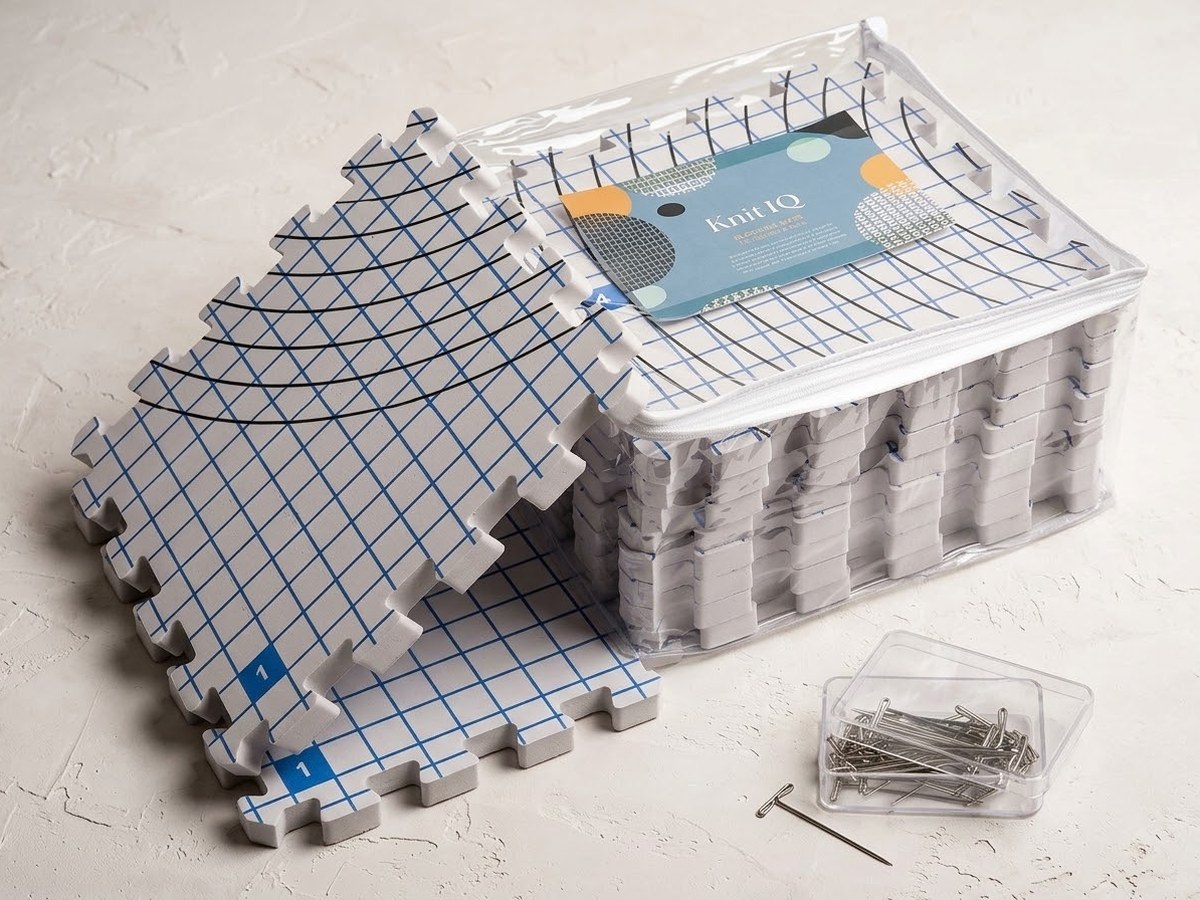
A pack of nine interlocking foam blocking mats printed with a grid and radial guide circles, with 100 T-pins and a storage bag included. Here is what the listing documents about the mat system, its guides and its pins, and what to consider before buying — this is an editorial guide based on supplied product information, not a hands-on test.
This article contains affiliate links. As an Amazon Associate I earn from qualifying purchases.
Affiliate link — CrochetSmith may earn a commission from qualifying purchases at no extra cost to you.
Quick facts
- Brand
- KnitIQ
- Product type
- Interlocking foam blocking mats
- Number of mats
- 9
- Material
- EVA foam — as listed
- Foam thickness
- 0.75 in — manufacturer-listed
- Guides
- Grid lines and radial/circular markings
- Pins
- 100 T-pins included
- Storage
- Reusable carry/storage bag
- Intended uses
- Crochet, knitting, lace and similar blocking projects
- ASIN
- B07VWBGKQ8
What these blocking mats are designed to do
Blocking is the step where a finished piece is dampened, wet or steamed and pinned to size so the stitches settle flat and even before the piece is used. A dedicated set of blocking mats gives you a stable, pinnable surface to work on, rather than improvising with a towel, a mattress topper or a cushion. This set is a pack of nine interlocking foam panels rather than one fixed board, which changes how you use it: instead of one set surface, you join as many or as few panels as a given piece needs.
Interlocking foam mat system
The nine mats are designed to interlock along their edges, in the same way as puzzle-style foam flooring tiles, so they can be joined into a larger blocking surface or used as a smaller cluster for a single piece. That is the practical advantage of a modular system over a single fixed board: the area you block can roughly match the piece in front of you, from one panel for a small swatch up to the full set for something larger. The listing gives the overall item dimensions as 13.94 × 12.99 × 8.27 inches, which reads as the packaged size of the set rather than the footprint of one assembled mat or the full joined surface — we have not been supplied with, and are not assuming, the dimensions of an individual mat or of the mats fully connected.
Grid lines and radial circles
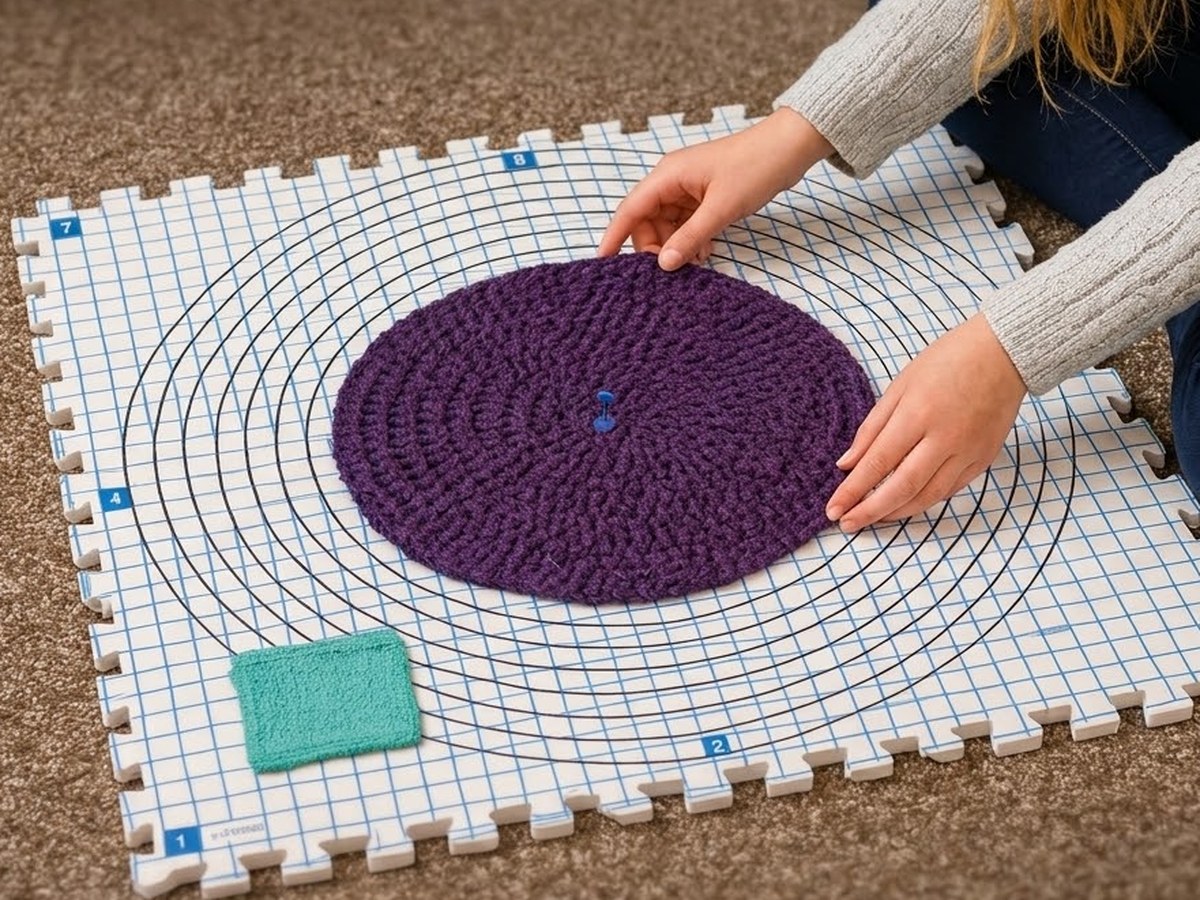
Each mat is printed with a square grid, and the assembled surface also carries a set of concentric radial circles. The straight grid lines work the way a cutting mat's grid does, giving you a reference for straight edges and even spacing. The circular guides are aimed at a different problem: round or symmetrical pieces — doilies, circular motifs, mandalas — where you are trying to keep a consistent radius all the way around rather than following a straight line. Having that reference printed on the mat is intended to make it easier to judge symmetry by eye; it does not guarantee a perfect circle, and how precisely a piece blocks out still depends on the piece itself and how it is pinned.
Affiliate link — CrochetSmith may earn a commission from qualifying purchases at no extra cost to you.
Foam thickness and pin holding
The listing describes the mats as 0.75-inch-thick EVA foam. A thicker foam is generally intended to give pins more material to anchor into and more resistance to a pin working loose than a thin mat would, which matters for a system that relies on T-pins placed anywhere on the surface rather than fixed holes. CrochetSmith has not tested this foam's density, how firmly it grips a pin over repeated use, or how it holds up to being pinned into in the same spots again and again, so we are not making a claim about pin retention or long-term durability here.
100 T-pins
The set includes 100 T-pins. A larger pin count matters most for pieces with a lot of edge to secure — a big shawl or blanket, a piece with many scalloped or curved points, or several smaller motifs blocked at once — where you can run out of pins from a smaller set before you have anchored the whole edge. The listing does not specify a pin material beyond describing them as T-pins, and we have not tested them for rust resistance, so we are not making a claim about that here.
Storage and portability
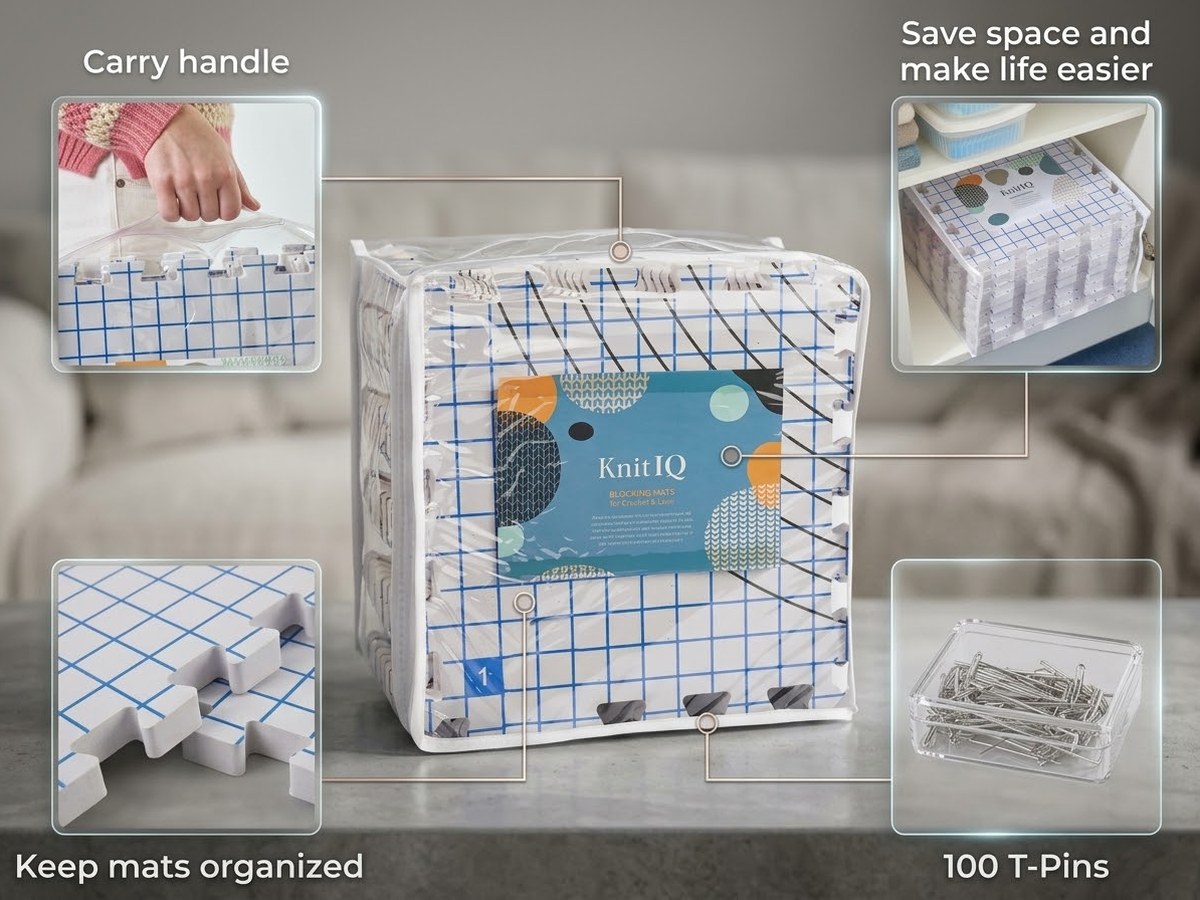
The set is supplied with a reusable, clear storage/carry bag sized to hold the stacked mats, and the supplied product images show a carry handle on the bag and the packed set fitting into a shelf or cubby. That is useful mainly for anyone who does not have a permanent spot to leave nine assembled mats set up, and would rather store them flat and bring them out only when blocking something.
Affiliate link — CrochetSmith may earn a commission from qualifying purchases at no extra cost to you.
Steam blocking considerations
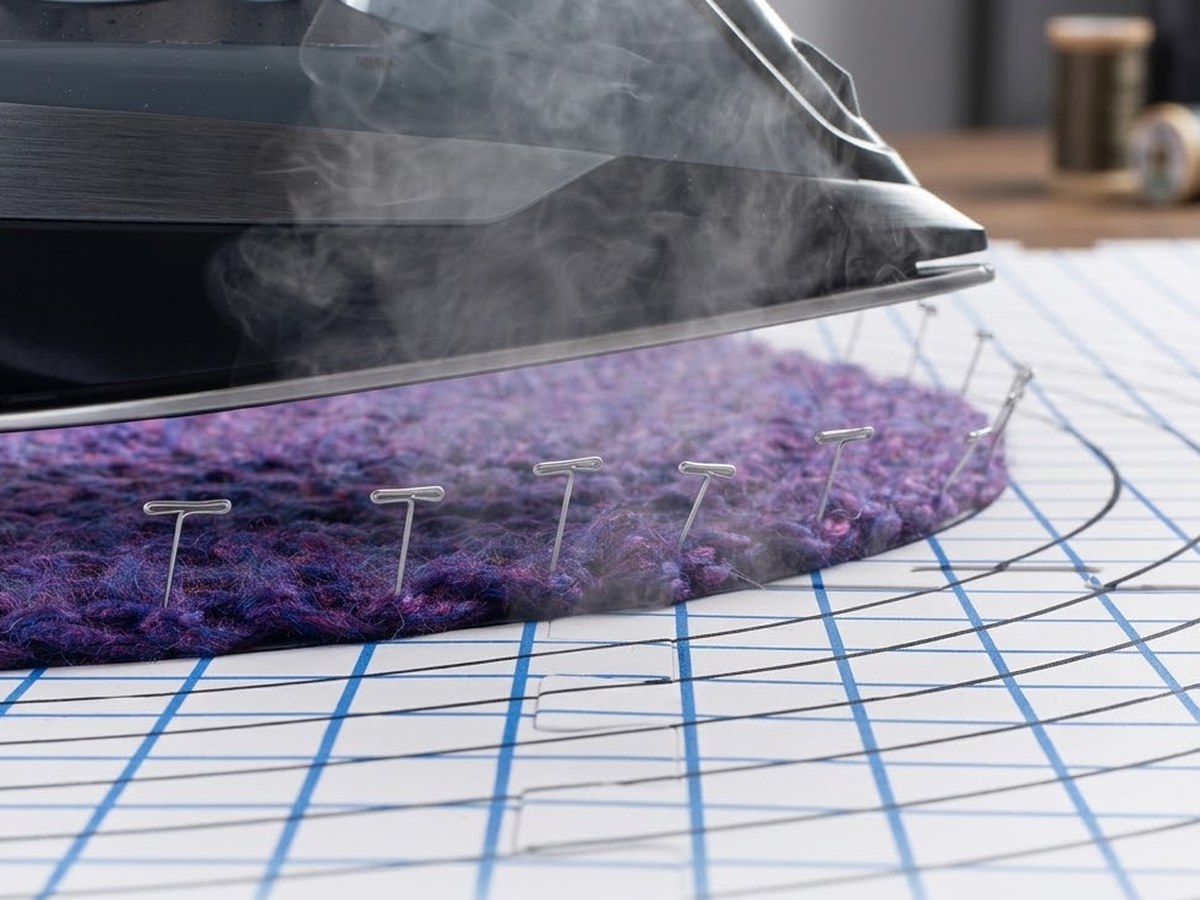
The supplied product material shows a piece pinned to the mats while steam is applied from an iron held above the fabric, and the manufacturer describes the mats and printed grid as designed to tolerate steam blocking. That is a listed, manufacturer claim rather than something CrochetSmith has independently tested: we have not measured how the foam or its printed surface responds to steam or heat over repeated use, and no maximum safe temperature was supplied, so we are not stating one. If you steam block, general guidance is to hold the iron or steamer above the piece rather than resting it directly on the fabric or the mat, and to test on a swatch first if you are unsure how a particular fibre will respond — acrylic yarn in particular can permanently flatten under steam. Our blocking basics guide covers wet, spray and steam blocking methods in more general terms, including that acrylic warning, regardless of which mats or board you use.
Affiliate link — CrochetSmith may earn a commission from qualifying purchases at no extra cost to you.
KnitIQ foam mats vs a wooden blocking board
CrochetSmith has also covered our OAKWOOMA wooden blocking board overview, and the two products suit different situations rather than one simply replacing the other. The OAKWOOMA board is a rigid, fixed-hole pegboard: a dense, pre-drilled grid that is particularly convenient for a repeated small motif, like a granny square, where the same pin pattern works each time. The KnitIQ mats are a modular, T-pin-based system instead — pins can go anywhere on the foam rather than into fixed holes, multiple panels join to cover a larger or oddly shaped piece, and the printed radial circles are specifically aimed at round work. Neither is a universal upgrade over the other: a rigid board suits repeatable small shapes well, while a modular foam system suits larger, irregular or circular pieces, or blocking more than one piece across a bigger joined surface.
Things to consider before buying
- Nine mats take up more storage space than a single board, even packed into the included bag.
- Foam and T-pins are a different working style from a rigid pegboard with fixed holes — which suits you may come down to preference as much as project size.
- The packaged item dimensions supplied are not the same as the assembled blocking area; CrochetSmith has not been given, and is not assuming, the size of one mat or the full joined surface.
- Only 100 pins are included; a very large project blocked all at once could still use more.
- Long-term foam durability and how the mats hold up to repeated steam exposure have not been independently tested by CrochetSmith.
Who this may suit
Potentially relevant for crocheters who
- block larger pieces, such as shawls or blankets
- make circular projects, doilies or mandalas and want radial guides
- are also knitters or lace makers blocking a range of shapes
- want a configurable surface rather than one fixed board size
- prefer placing pins freely with T-pins over a fixed peg pattern
Perhaps less relevant for crocheters who
- only ever block small granny squares and are happy with a fixed peg board
- have very limited storage space for nine mats and their bag
- specifically want a solid wooden blocking surface rather than foam
CrochetSmith's take
On paper, the KnitIQ set is an interesting alternative to a rigid blocking board: nine interlocking foam mats that can be arranged to suit the piece in front of you, a printed grid and radial circles aimed specifically at round work, 100 T-pins, and a bag to keep it all together when it is not in use. That modularity is really the point of difference from a board like the OAKWOOMA — a configurable surface for varied or larger pieces, next to a fixed grid that suits repeated small motifs.
We have not hands-on tested this set, so we are not making claims about how securely the panels interlock in practice, how well the foam holds pins over time, or how the mats and their printed surface actually respond to steam.
Interested in the KnitIQ blocking mats?
KnitIQ Blocking Mats for Knitting & Crochet, Pack of 9
- 9 interlocking EVA foam mats — 0.75 in thick, as listed
- Grid lines and radial/circular guides
- 100 T-pins included
- Reusable storage/carry bag
As an Amazon Associate I earn from qualifying purchases. If you buy through this link, CrochetSmith may earn a commission at no additional cost to you.